Is Commercial Solar a Good Investment for Your Business?
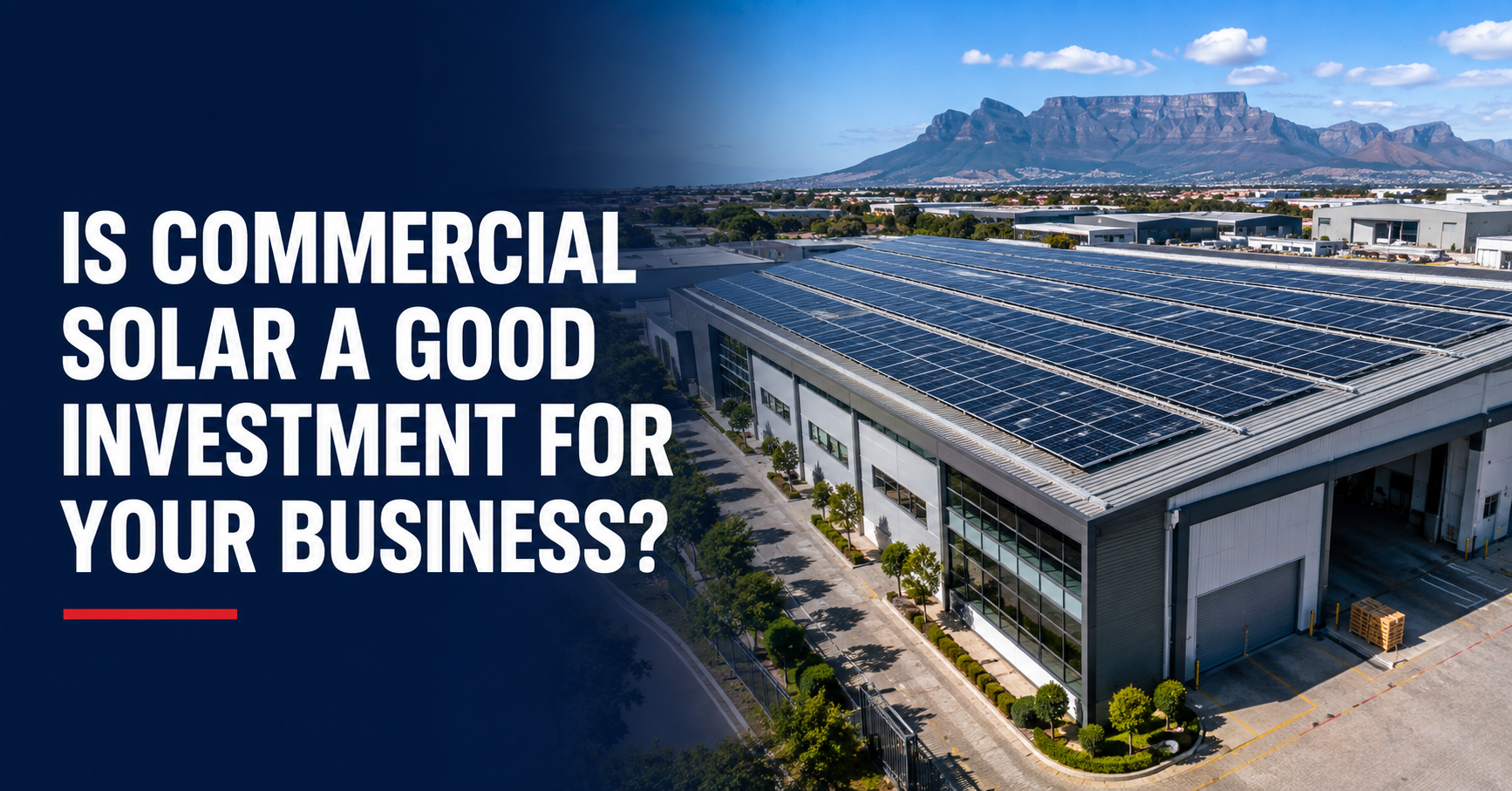
Is Commercial Solar a Good Investment for Your Business?
For many South African businesses, electricity is no longer simply a monthly expense. It has become an operational risk.
Rising electricity costs, power interruptions and limited supply capacity can affect production, customer service, security systems and profitability. This is why more businesses are considering commercial solar—not only as backup power, but also as a long-term investment in lower operating costs and improved energy security.
However, commercial solar is only a good investment when the system is designed around the actual needs of the business.
How commercial solar can save your business money
Many businesses consume most of their electricity during daylight hours, which is also when solar panels produce the most power.
A correctly designed solar system can supply part of this daytime demand directly from the panels. This reduces the amount of electricity purchased from the municipality or Eskom.
Businesses with consistent daytime loads generally have the greatest opportunity to use the available solar production effectively. These may include:
-
Factories and workshops
-
Farms and agricultural operations NF
-
Retail stores and shopping centres puro
-
Offices and commercial buildings
-
Lodges and guesthouses
-
Schools and training centres
-
Warehouses and cold-storage facilitiesresso
-
Property developments and housing projects
The more solar energy the business can use while it is being produced, the greater the potential electricity saving.
Depending on the energy requirements of the business, solutions can range from smaller three-phase installations to a 100 kW commercial solar system or larger multi-megawatt projects.
Solar-only, battery backup or a hybrid system?
A commercial solar installation does not always require a large battery bank. The correct configuration depends on what the business wants to achieve.
Solar-only system
A solar-only or grid-tied system is primarily designed to reduce daytime electricity consumption. It can offer a more affordable entry into commercial solar when backup power is not the main requirement.
However, most standard grid-tied systems switch off during a power failure for safety reasons.
Solar with battery backup
Commercial battery-storage systems can continue supplying selected equipment during a power interruption, subject to the inverter capacity, battery capacity and overall system design.
Businesses should first identify their essential loads. These could include:
-
Computers and internet equipment
-
Security and access-control systems
-
Lights
-
Refrigeration
-
Point-of-sale systems
-
Pumps and selected machinery
-
Production equipment that cannot be interrupted
Backing up only essential equipment can be considerably more cost-effective than attempting to operate the entire business from batteries.
Hybrid commercial system
A hybrid system combines solar production, battery storage and the electrical supply. Depending on the equipment and configuration, it can reduce electricity purchases while also providing backup power for selected loads.
Correct system sizing is essential
Commercial solar systems should never be sized from the electricity bill alone.
The assessment should consider:
-
Monthly electricity consumption
-
Daytime and nighttime usage
-
Maximum demand
-
Single-phase or three-phase supply
-
Operating hours
-
Seasonal changes in consumption
-
Essential and non-essential loads
-
Motors, pumps and machinery
-
Equipment starting currents
-
Available roof or ground space
-
Future expansion plans
Larger businesses may require three-phase hybrid inverters specifically designed for commercial loads, battery storage and three-phase electrical supplies.
A machine may consume a certain amount of power while running but require substantially more power for a short period when starting. This is especially important for pumps, compressors, refrigeration equipment and large electric motors.
If these starting currents are ignored, an inverter may appear large enough on paper but still be unable to start the equipment reliably.
Your electricity bill is the starting point
A recent electricity bill helps identify the tariff, monthly consumption and applicable demand charges. However, a proper commercial assessment may also require interval data, operating schedules and measurements of the actual loads.
This information allows the system designer to estimate:
-
The appropriate solar-array size
-
How much solar energy can be used directly
-
The required inverter capacity
-
Whether battery storage is justified
-
Which loads can be supported during an outage
-
The expected reduction in grid consumption
Savings and payback periods should be based on realistic consumption data—not generic promises.
Roof space and structural suitability
Commercial solar installations often require a substantial number of panels. Before installation, the available roof area, orientation, shading and roof condition must be assessed.
The roof must also be capable of safely supporting the panels and mounting structure. A structural assessment may be required, particularly on older buildings or where there is uncertainty about the roof’s load-bearing capacity.
If the roof is unsuitable, a properly engineered ground-mounted system may be an alternative where sufficient land is available.
Compliance cannot be treated as an optional extra
A commercial solar system must be designed and installed with the correct:
-
AC and DC protection
-
Circuit breakers, fuses and isolators
-
Surge protection
-
Earthing and bonding
-
Cable specifications
-
Cable support and clamping
-
Equipment identification
-
Circuit labels
-
Warning notices and danger indicators
The final installation must be inspected, tested and commissioned by the appropriate qualified persons. An electrical Certificate of Compliance must be issued by the appointed registered electrical contractor for the applicable electrical work.
Depending on the municipality, supply authority and type of system, Small-Scale Embedded Generation registration or approval may also be required.
What determines the return on investment?
The return on a commercial solar investment depends on several factors:
-
The business’s electricity tariff
-
Annual electricity consumption
-
Daytime energy demand
-
Solar-array size
-
How much solar production is used on site
-
Equipment and installation costs
-
Battery size and replacement considerations
-
Maintenance requirements
-
Future electricity-price increases
-
Finance costs, where applicable
A system with a very large battery bank may provide excellent backup but have a different financial return from a solar-focused system designed mainly to reduce daytime electricity purchases.
The best solution is therefore not automatically the biggest system. It is the system that best matches the business’s consumption pattern, operational risks and available budget.
Is commercial solar right for your business?
Commercial solar may be a worthwhile investment if your business:
-
Has significant daytime electricity consumption
-
Wants to reduce long-term operating costs
-
Loses productivity during power interruptions
-
Depends on refrigeration, security, connectivity or machinery
-
Has suitable roof or ground space
-
Plans to remain at the property for several years
-
Wants greater control over its energy supply
Before accepting a quotation, request a proper assessment and make sure the proposed system explains what it will power, what it is expected to save and what is included or excluded.
Start with a commercial solar assessment
RSA Solar Supplier supplies solar solutions for businesses, farms, workshops, lodges, property developments and industrial applications.
To begin an assessment, send us:
-
A recent electricity bill
-
The business address
-
Operating hours
-
Details of the electrical supply
-
A list of essential equipment
-
Photographs of the main distribution board
-
Roof photographs or details of the available ground-mounting area
-
Details of motors, pumps or heavy machinery
We can then help identify an appropriate solution based on your business’s actual requirements.
Ready to find out whether commercial solar is a good investment for your business? Complete our commercial solar assessment form and provide us with your electricity usage, operating hours and essential-load requirements. RSA Solar Supplier will help you identify a suitable solution based on your business’s actual needs.
Request a commercial solar assessment
Contact RSA Solar Supplier
Call or WhatsApp: 081 729 5101 / 065 008 2530
Email: sales@solarsupplier.co.za
Website: www.solarsupplier.co.za
Every commercial installation is different. System performance, savings, backup duration and return on investment depend on site conditions, consumption patterns, system design and applicable electricity tariffs. Structural assessments, engineering services and SSEG applications are excluded unless specifically included in the quotation.